







Trust setup, amendments and documents for ongoing management

FAQs

Who should be the appointor?

The appointor (sometimes called Principal or Guardian) is the ultimate controller of a trust. The appointor has the power to appoint and remove the trustees. It is not essential that the trust has an appointor. CGW deeds will work with or without an appointor.

However, it is useful to have an appointor to change the trustee in situations such as death or insolvency of a trustee. The appointor may be an exisitng trustee, a named beneficiary or a third party.

Some trusts have an ‘independent’ appointor (such as an accountant) to reduce the risk of individual beneficiaries being held to control the trust.

We recommend against having a sole individual trustee who is also a beneficiary.

There is an argument that, where a sole trustee is also a beneficiary, all of the net income is assessable to that trustee because they have the unilateral power to retain or distribute to other beneficiaries.

While we are only aware of one occasion where the ATO has raised this as a possible issue, the prudent approach is to have joint trustees for clients who do not want a corporate trustee. If there are joint trustees then no beneficiary has unilateral power to determine how the income is distributed.

The maximum number of trustees you can have is four.

A trustee is personally liable for debts incurred on behalf of the trust and, although the trustee has the right to be indemnified out of the assets of the trust, it is usually preferable for a sole purpose company to be trustee so that the risk of trust activities is quarantined to the assets in the trust.

With individual trustees, all assets have to be transferred into the name of a new trustee if a current trustee resigns or dies. However if the trustee is a company there is no need to transfer assets if a director dies or resigns.

The costs associated with maintaining a corporate trustee are not substantial.

The directors of a trustee company can be beneficiaries in their individual capacity while still being in control of the trust.

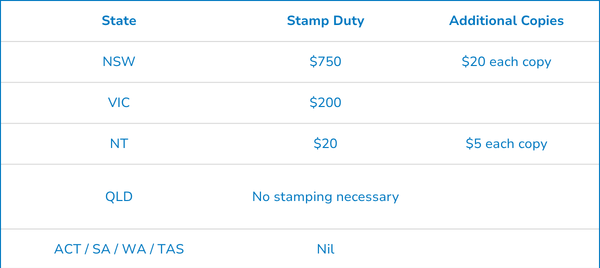
Generally, the establishment of a trust deed will be subject to either nil or nominal duty. The requirements in relation to stamping a trust deed vary from state to state. The stamping fees for discretionary and unit trusts, if by declaration/settlement of cash only are set out below:
There are a number of issues you should take into account in choosing between a fixed and a non-fixed unit trust. The key differences are sumarised below:
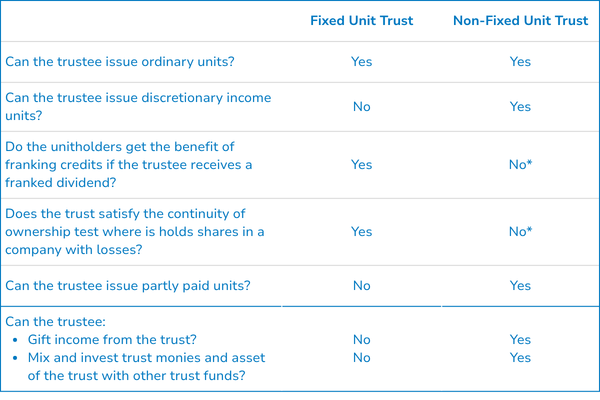
*Unless the trust lodges a family trust election

Recent cases also highlight the fact that most private unit trusts do not meet the current criteria for a fixed trust – therefore if you have an existing unit trust deed, you may need to update it if you require the trust to be fixed.

A fixed trust is more restrictive than our ordinary unit trust, which may be a problem if there are non-arm’s length unitholders.

For example, many decisions have to be approved by a unanimous resolution of unitholders (e.g. amendments to the trust deed).

Recent cases also indicate that, unless unit redemptions and issues have to be based on a valuation determined on a net asset basis and in accordance with Australian accounting principles, the unitholders may not have a fixed entitlement.

While we do not agree with the recent case law, it is likely the ATO will seek to take this valuation position and therefore the safest option is to include these valuation methods in the unit trust deed.

The deed can be amended in future (by unanimous consent) if an alternative valuation method is agreed.

A direct descendants trust deed contains provisions which prohibit capital distributions to anyone other than a direct descendant of the initial clients unless the initial clients consent.

This deed may be attractive to clients who have concerns about sons or daughters-in-law or other third parties (e.g. trustee in bankruptcy) accessing the trust capital.

However, the trust has the usual wide range of income beneficiaries so the clients still have substantial flexibility for tax planning purposes.

Setting up a trust

CGW Structures provides trust structures that are written in modern, easy to understand language. 

We can provide traditional discretionary trust deeds or deeds that have been tailored to meet specific requirements. 

For example, we offer deeds where the eligible capital beneficiaries are restricted to the initial clients and their direct descendants and our unit trust deed can be flexible to allow discretionary income distribution or ‘fixed’ to ensure compliance with the loss trust and non-arm’s length provisions in the Tax Acts.

Different types of trust deeds

Discretionary trusts are also commonly known as ‘family trusts’.

A discretionary trust provides flexibility by offering a wide range of beneficiaries without any particular beneficiary having a fixed interest.

Beneficiaries of discretionary trusts are commonly separated into categories

  • It is generally intended that the primary beneficiaries will receive the majority of the benefits from the trust.
  • The secondary beneficiaries are the relatives of the primary beneficiaries (as well as tax exempt and some other organisations).
  • The tertiary beneficiaries are generally related companies, trusts and other entities.


The trustee makes decisions for the trust and has the discretion to distribute income and capital to any of the beneficiaries on a flexible basis. This allows parties the opportunity to assess their tax position on a year-by-year basis and distribute income in a way so as to achieve the most effective after tax distribution of income.

The appointor is the person who has the power to change the trustee and for this reason the appointor has the ultimate control.

A direct descendants trust is a type of discretionary trust that contains provisions generally preventing the trustee from making capital distributions to anyone other than a direct descendant of the nominated beneficiaries (usually the primary beneficiaries).

This type of trust may be attractive to clients who have concerns about non-immediate family members (such as sons-in-law and daughters-in-law) or third parties accessing the assets of the trust.

However, despite this restriction the trust will still have the usual wide range of income beneficiaries which provides flexibility for tax planning purposes.

Unit trusts are commonly used as business structures because they allow for the distribution of income and capital in fixed proportions according to the number and class of units held by the unitholders.

A normal unit trust allows for the issue of ordinary units, partly-paid units and discretionary income units (special units).

The discretionary income units can be particularly useful where clients want to have fixed capital entitlements in the trust but want to have flexibility with income distributions.

A fixed unit trust is a creature of the ‘tax world’.

Many people mistakenly believe that all unit trusts are ‘fixed trusts’. This is not the case.

Unless there are specific provisions limiting the power of the trustee to issue or redeem units and to vary the trust (as well as other issues), the trust will not be a fixed trust.

There are a number of situations where it is important that a unit trust qualifies as a fixed trust:

  • A trust that holds shares in a company will only be able to get the benefit of franking credits on dividends if it is a fixed trust or makes a family trust election.
  • If a trust owns 51% or more of the shares in a company that has losses, the company may not satisfy the continuity of ownership test unless the trust is a fixed trust or makes a family trust election.
  •